

Many legal practices in Indonesia still rely on spreadsheets, chat applications, and manual reporting to manage daily operations. While this approach may work temporarily, operational problems become unavoidable as the firm grows. This is why software for law firms is becoming increasingly important for firms that want better efficiency, accurate billing, and stronger case management.
From a practical operational perspective, the issue is rarely legal expertise. Most firms already have capable lawyers. The real challenge usually comes from fragmented workflows, inconsistent reporting, and poor operational visibility.
Partners often struggle to monitor billable hours, outstanding invoices, case progress, and lawyer workloads in real time. When operational information is scattered across different platforms, decision-making becomes slower and less accurate.
How Software for Law Firms Improves Daily Operations
One of the biggest operational risks inside legal practices is revenue leakage caused by incomplete time tracking.
Many lawyers forget to record small but billable activities such as:
- Client discussions
- Legal research
- Contract revisions
- Internal strategy meetings
- Court preparation
Over time, these unrecorded activities create substantial financial losses.
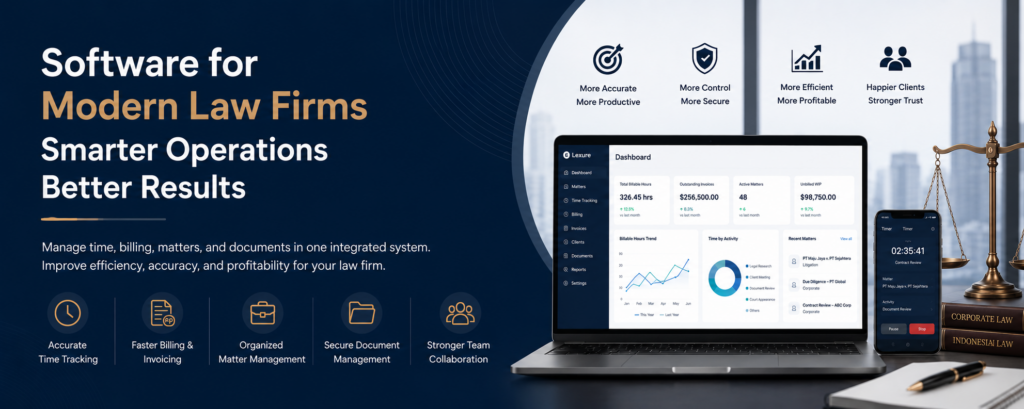
Modern legal management platforms solve this by centralizing attorney timesheets, billing systems, document management, and legal tracking into one operational environment.
A properly implemented system helps firms:
- Monitor billable hours accurately
- Generate invoices faster
- Reduce administrative workload
- Improve legal time management
- Track case progress efficiently
- Strengthen internal collaboration
For firms handling multiple matters simultaneously, operational visibility becomes essential, not optional.
Why Growing Firms Need Software for Law Firms Earlier
Many law firms delay operational improvements because existing systems still appear manageable.
However, manual workflows become increasingly inefficient as teams expand. Additional staff members, larger client portfolios, and more legal matters create operational complexity that spreadsheets cannot handle effectively.
A mid-sized litigation firm in Jakarta recently faced recurring billing delays because associates submitted timesheets inconsistently. Invoice preparation required several days every month, creating cash flow delays and administrative stress.
After implementing a centralized legal tracking software system, the firm reduced billing preparation time significantly while improving invoice accuracy.
This is a common pattern across growing firms.
The firms operating efficiently today are not necessarily the largest firms. They are the firms that build structured operational systems before inefficiency becomes expensive.
In practice, modern clients also expect faster updates, transparent billing, and organized communication. Firms with stronger operational systems naturally deliver better client experiences and improve long-term client retention.
How Modern Law Firms Improve Efficiency with Better Systems
Legal operations have become a major factor in profitability and scalability. Firms that continue relying on fragmented workflows often experience hidden operational losses without realizing it.
Implementing the right software for law firms helps legal teams improve billing accuracy, organize case management, strengthen legal time management, and reduce operational inefficiencies across the practice.
For modern law firms in Indonesia, operational structure is no longer just an administrative advantage, it is a business necessity.