


As the end of the month approaches, many law firms face the same routine. Lawyers submit their timesheets, administrators consolidate activities from multiple files, and partners wait for reports before invoices can be issued. At the same time, the status of several matters often needs to be confirmed because the latest updates are stored across different systems.
This does not mean your legal team is inefficient. In fact, as the number of clients and matters grows, administrative processes naturally become more complex. When time tracking, matter updates, and billing are managed manually, coordination takes longer and administrative work continues to increase. This is where legal e-billing software provides value by bringing legal operations together in a single, integrated platform.
Why Manual Billing Becomes a Challenge for Law Firms
Lawyers are primarily focused on delivering high-quality legal services. Behind the scenes, however, every engagement requires essential administrative tasks, including recording billable hours, updating matter progress, managing legal documents, and preparing client invoices.
Many law firms still rely on spreadsheets, email threads, or separate communication tools to manage these processes. While this approach may work for smaller firms, it becomes increasingly difficult to maintain as the firm grows.
Administrators often spend valuable time following up with lawyers to complete timesheets, while partners must gather information from multiple sources just to understand the status of ongoing matters. As a result, billing is frequently delayed because the required information is not readily available.
When Operations Start Slowing Down Your Law Firm
Operational inefficiencies are not always obvious at first. However, as administrative tasks increase, they begin to consume more time across the firm.
Partners need reports from multiple sources before making business decisions. Administrators repeatedly verify information to ensure billing accuracy. Meanwhile, lawyers spend time updating several systems instead of focusing on client work.
Over time, this affects overall operational efficiency. Billing cycles become longer, internal coordination becomes more complex, and visibility into matter progress decreases. Reliable, real-time information is essential for making informed decisions and maintaining consistent client service.
Case Study: When Spreadsheets Can No Longer Support Growth
Consider a boutique law firm with ten lawyers handling both litigation and corporate matters. Billable hours are tracked in spreadsheets, while matter updates are shared through email and messaging applications.
At the end of each month, administrators spend several days collecting and verifying timesheets before invoices can be prepared. At the same time, partners still need to contact individual lawyers to confirm the latest progress of ongoing matters.
This situation is common among growing law firms. Processes that once worked well become increasingly inefficient as the firm’s workload, client base, and team continue to expand.
Manual Solutions Help, But They Have Their Limits
Many law firms have already taken steps to improve their administrative workflows by creating standardized timesheet templates, implementing internal procedures, or improving spreadsheet management.
These efforts certainly help establish consistency. However, manual processes still depend heavily on individual discipline and timely data entry. As the number of lawyers, clients, and matters increases, maintaining consistency becomes significantly more difficult.
In addition, information remains scattered across multiple platforms, making it harder to generate accurate reports and gain a complete view of firm operations.
How Legal E-Billing Software Improves Law Firm Operations
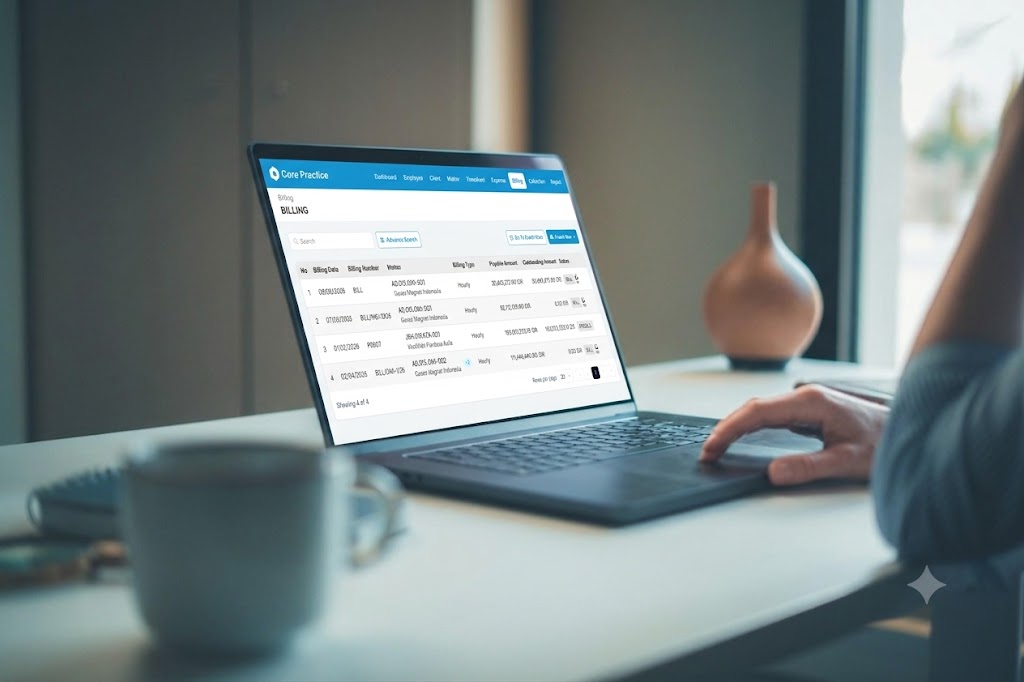
This is where legal e-billing software offers a more efficient approach. Rather than functioning solely as an invoicing tool, it connects billable hours, matter management, document management, and billing into a single workflow.
With all activities recorded from the beginning, administrators no longer need to consolidate information manually. Partners gain real-time visibility into matter progress through operational dashboards, while lawyers only need to record their work once to support multiple administrative processes.
An effective legal e-billing solution should include:
- Billable hours and timesheet tracking
- Matter management for monitoring legal work
- Invoice generation based on recorded activities
- Operational dashboards for performance and workload visibility
- Secure document management with role-based access controls
By integrating these functions, law firms can reduce repetitive administrative work while improving visibility across their legal operations.
The growth of a law firm depends not only on legal expertise but also on operational excellence. When timesheets, matter management, and billing are handled separately, administrative complexity increases and valuable time is lost.
By implementing legal e-billing software, law firms can centralize these processes within a single platform. This enables better collaboration, improves operational visibility, and streamlines billing without adding unnecessary administrative burdens.
As firms continue to grow, investing in the right legal operations technology helps build a more efficient, scalable, and client-focused practice.
Frequently Asked Questions
What is legal e-billing software?
Legal e-billing software is a solution that helps law firms manage billable hours, invoicing, billing workflows, and legal operations within one integrated platform.
What are the benefits of legal e-billing software?
It simplifies administrative tasks, speeds up billing, improves matter visibility, and enhances collaboration across legal teams.
How is legal e-billing software different from standard invoicing software?
Traditional invoicing software focuses only on creating invoices. Legal e-billing software connects invoices with billable hours, matters, lawyer activities, and legal operations.
When should a law firm adopt legal e-billing software?
A law firm should consider adopting legal e-billing software when its growing number of lawyers, clients, and matters makes manual processes increasingly time-consuming and difficult to manage.
If your firm is still managing timesheets, matters, and billing across multiple systems, it may be time to consider a more integrated approach.
Schedule a ProHukum demo to see how a modern legal operations platform can simplify your workflows, improve efficiency, and streamline your e-billing process from start to finish.