


Managing lawyer time is not only about knowing how long a task takes to complete. For law firms, every working hour has value because it is connected to legal matters, client services, and the billing process within the firm.
That is why billable hours software has become increasingly relevant for law firms that want to build a more structured time tracking system and gain better visibility into how professional activities are managed.
However, many law firms still face challenges in transforming lawyer activities into organized and useful data.
Every day, lawyers handle various tasks such as client consultations, legal research, document reviews, and case related communication. All of these activities require time, yet they are not always recorded accurately.
Without proper time tracking, law firms may struggle to understand completed work, team capacity, and the overall billing process with clients.
As legal operations become more complex, the use of billable hours software helps law firms build a more structured, transparent, and manageable way of working.
Why Managing Lawyer Timesheets Is a Challenge for Law Firms
As the number of legal matters and client demands continues to grow, lawyers often handle multiple activities at the same time.
Throughout a working day, a lawyer may move between client meetings, contract reviews, legal research, document preparation, internal discussions, and monitoring case progress.
Each activity requires professional time and contributes value to the legal service provided.
However, the challenge appears when all of these activities need to be recorded consistently and accurately.
Many lawyers naturally prioritize completing legal work rather than documenting every detail of their working hours. As a result, some activities may be forgotten, recorded incompletely, or fail to represent the full scope of work performed.
Challenges Law Firms Face When Managing Attorney Timesheets
1. Lawyer Activities Are Not Always Recorded Accurately
Manual time tracking can create a gap between the work actually performed and the information recorded.
For example, a lawyer may complete multiple tasks related to one matter throughout the day. However, when the timesheet is completed later, only the main activity may be recorded.
As a result, important details about the lawyer’s work may not be fully captured.
2. Difficulty Understanding Time Distribution and Team Workload
For managing partners, understanding how professional time is allocated is an important part of managing a law firm.
Without structured data, firms may find it difficult to identify:
- Which matters require the most time
- How workload is distributed among lawyers
- The capacity of each team member
- Which priorities require more attention
With better visibility, law firm leaders can make more informed decisions based on actual operational conditions.
3. Billing Processes Become Less Effective
In many law firms, lawyer working hours are an important foundation for billing.
When time records are incomplete, preparing invoices and reviewing legal work can become more challenging.
The issue is not only about the number of hours worked, but also about how law firms communicate the value of completed work to clients.
How Billable Hours Software Supports Modern Law Firm Operations
The use of billable hours software helps law firms create a more structured time management process.
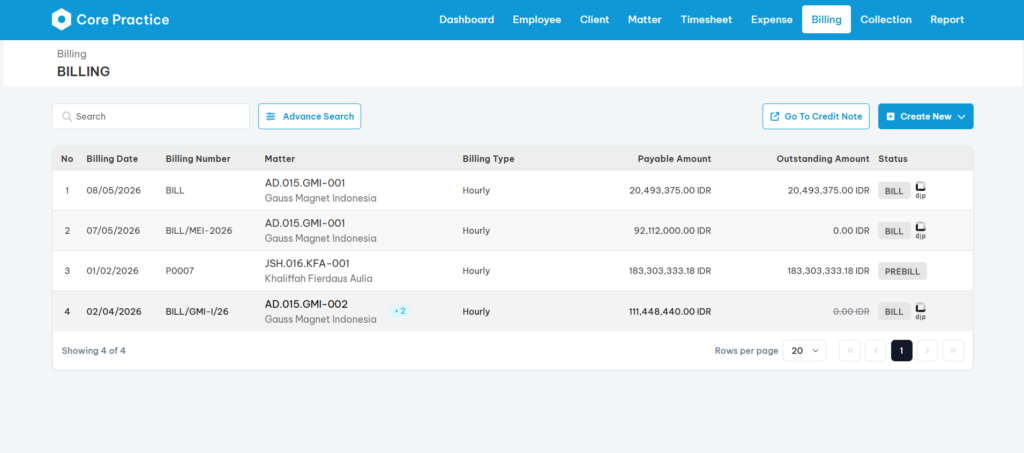
Through a digital system, lawyers can organize activities based on clients, legal matters, types of work, and time spent.
This allows law firms to maintain clearer records of how professional time is used.
In addition, collected data can support internal evaluations and provide better insights into the firm’s operational activities.
Technology does not replace the role of lawyers. Instead, it helps legal professionals work with better-organized information and stronger operational visibility.
The Role of Billable Hours Software in Law Firm Billing Management
Billable hours are an important concept in many legal practices.
Simply put, billable hours refer to the time lawyers spend performing work that can be charged to clients.
For example:
- A legal consultation completed within 1 hour
- Document review completed within 2 hours
- Legal opinion preparation completed within 3 hours
However, accurate calculation requires reliable time records.
This is why many law firms are exploring solutions such as:
- Software timesheet lawyer
- Legal billing software
- Legal practice management software
to support better time tracking and billing management.
How to Calculate Lawyer Billable Hours with Better Time Tracking Software
Calculating lawyer billable hours is not only about measuring the amount of time spent completing a task.
Law firms also need to understand the broader context behind the work, including the activities performed, the legal matters handled, and the value delivered to clients.
With structured time tracking, law firms can better understand how professional time is used and how these activities connect with the legal services provided.
This provides firms with clearer insights into operations, matter management, and client billing processes.
Why Law Firms Are Adopting Legal Billing Software and Digital Systems
The legal industry continues to evolve.
Clients increasingly expect greater transparency, while law firms need better ways to manage professional resources and operational activities.
As a result, time management has become an important part of modern law firm operations.
Using billable hours software is not only about recording working hours. It is about creating a more structured, measurable, and sustainable way of managing legal practices.
Improve Law Firm Operations with Billable Hours Software
Managing lawyer time effectively is an important step in building a modern legal operation.
With the right system, law firms can gain better visibility into activities, legal matters, and team workflows.
ProHukum helps law firms manage essential legal operations in one platform, including matter management, lawyer activities, and time tracking in a more organized way.
Frequently Asked Questions
What is billable hours software?
Billable hours software is a system that helps law firms record, manage, and monitor lawyer working hours that can be billed to clients.
Why do law firms need lawyer timesheet software?
Because manual tracking can make work activities difficult to monitor and may result in incomplete time records.
How are timesheets related to law firm billing?
Timesheets help law firms track lawyer activities, which become an important foundation for billing and invoice preparation.
Is billable hours software only for large law firms?
No. Law firms of different sizes can use time management systems based on their operational needs.