

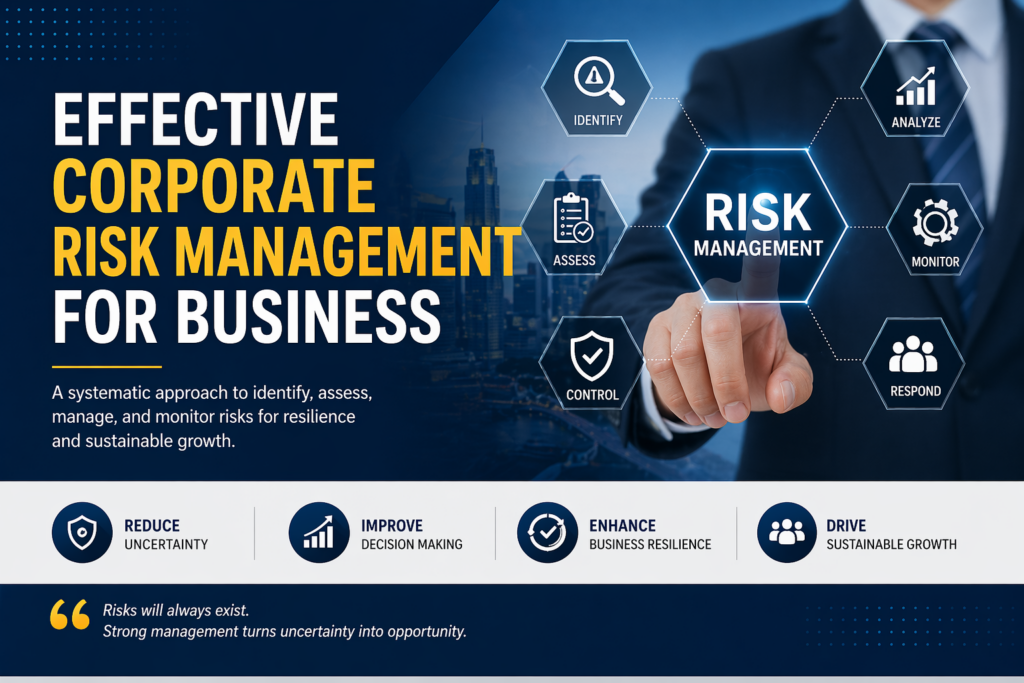
Enterprise risk management is a critical process for maintaining business stability and driving sustainable growth. It goes beyond documentation and focuses on how risks are actively managed within daily operations. Many organizations already have frameworks in place, yet not all execute them consistently.
However, risk is not static. Every business decision can introduce new risks. Therefore, companies need a structured and continuous approach. With the right system, risks can be identified and controlled before they create significant impact.
Key Stages in Enterprise Risk Management
The implementation of enterprise risk management begins with governance. This stage defines direction, risk appetite, and accountability across the organization. Next, risk identification is conducted to uncover potential threats across operational, financial, and strategic areas.
This is followed by risk assessment and analysis. The goal is to evaluate impact and likelihood. Based on this, organizations can prioritize risks and determine the most appropriate response, whether to avoid, mitigate, transfer, or accept them.
Companies then implement controls, which may be preventive or detective in nature. In addition, monitoring and reporting are conducted regularly to track risk performance through KPIs and KRIs.
When risks materialize, incident management plays a key role in handling events. This includes identifying root causes and implementing corrective actions. All these stages must be interconnected to ensure the system operates effectively.
Why Enterprise Risk Management Must Be Continuous
The success of enterprise risk management lies in consistency. Mature organizations do not stop at assessing risks; they manage them continuously. They integrate risk considerations into both strategic planning and daily operations.
Moreover, the use of real-time data allows organizations to monitor risk exposure more accurately. Feedback loops across processes further strengthen decision-making. As a result, companies can respond more quickly to changes.
On the other hand, if risk management is treated only as documentation, it becomes ineffective. Organizations may produce reports, but fail to truly manage risks.
The Role of Enterprise Risk Management in Building Business Resilience
Ultimately, corporate risk management plays a vital role in building business resilience. An integrated system helps reduce uncertainty and enhances confidence in decision-making.
With consistent execution and continuous improvement, organizations can not only manage risks effectively but also unlock more stable and sustainable growth opportunities.